1,000 Paper Cranes: PAACH unveils new mural
This story was originally published on April 28th 2025 in Penn Today.
Writer: Tina Rodia
Photographer: Eric Sucar
Members of Penn’s Pan-Asian American Community House (PAACH) unveiled a new mural ahead of Asian/Pacific American Heritage Month in the ARCH building at an event on April 16.
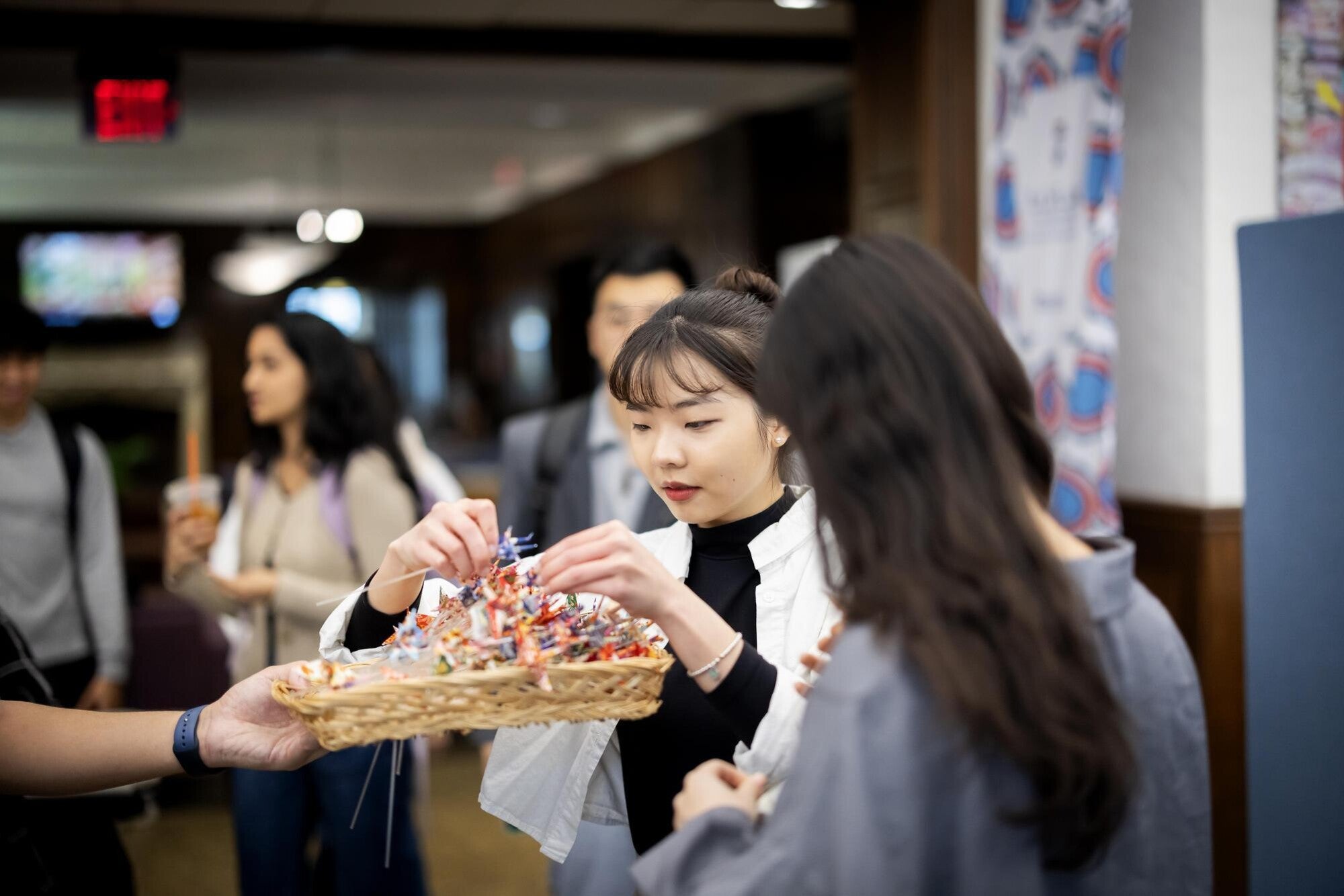
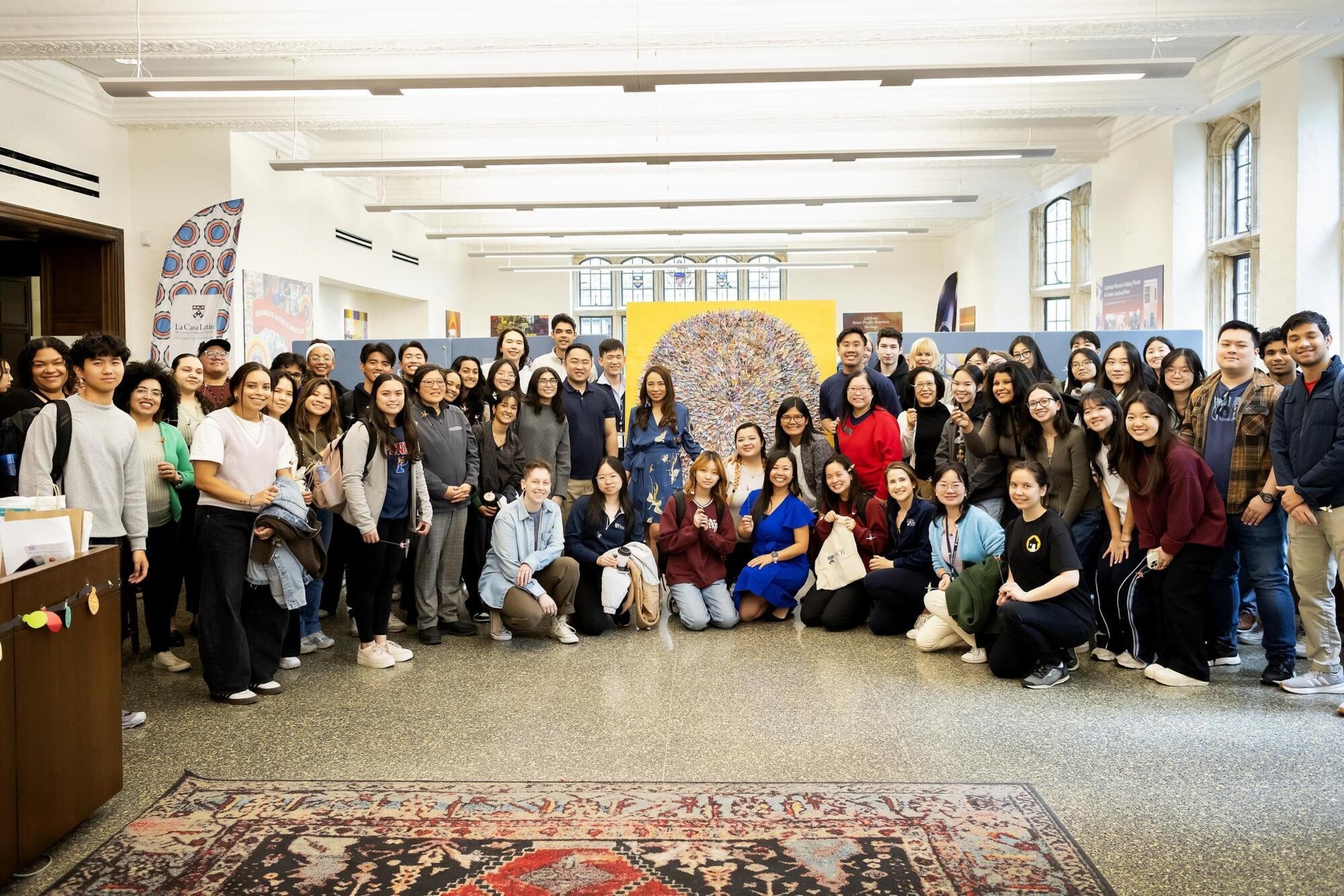
tudents, faculty, and staff members gathered in the lobby at Penn’s ARCH building, passing around baskets of small origami cranes. The month of May is Asian / Pacific American Heritage Month, and the Pan-Asian American Community House (PAACH) team holds its annual mural unveiling in April as a preview event for APA heritage month. “We host the celebration before the month of May, before students leave campus,” said Mei Long, director of PAACH.
Established by Congress in 1992, APA heritage month was designated in May in recognition of two historical events: the arrival of the first Japanese immigrant to the U.S. in May 1843, and the completion of the transcontinental railroad in May 1869. Standing beside the concealed mural before its reveal, Long explained why the railroad was significant: It was largely built by approximately 20,000 Chinese laborers. At its completion, the railroad cut travel time from New York to San Francisco from several months to just seven days.
“The railroad united the country and made a strong foundation for the economic prosperity in the years that followed,” said Long. “But the Chinese laborers suffered prejudice, abuse, significantly lower wages, and social isolation. The laborers organized strikes for better conditions.” These strikes, Long explained, “paved the way for labor rights that benefit all of us today.”Tina
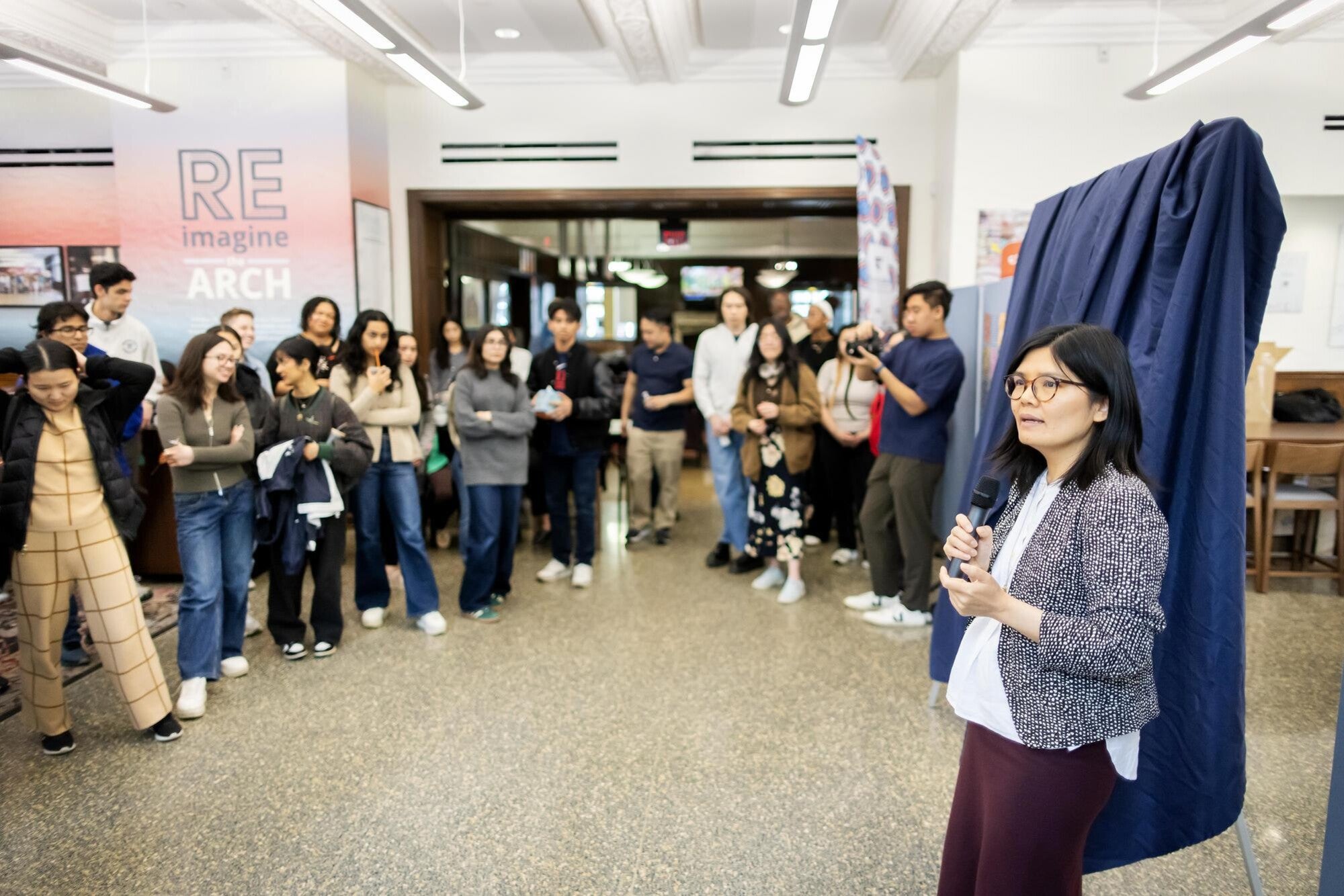
Long offered another history lesson. “PAACH is celebrating 25 years in 2025, after Penn students called for an Asian Pacific Islander cultural resource center in 2000.”
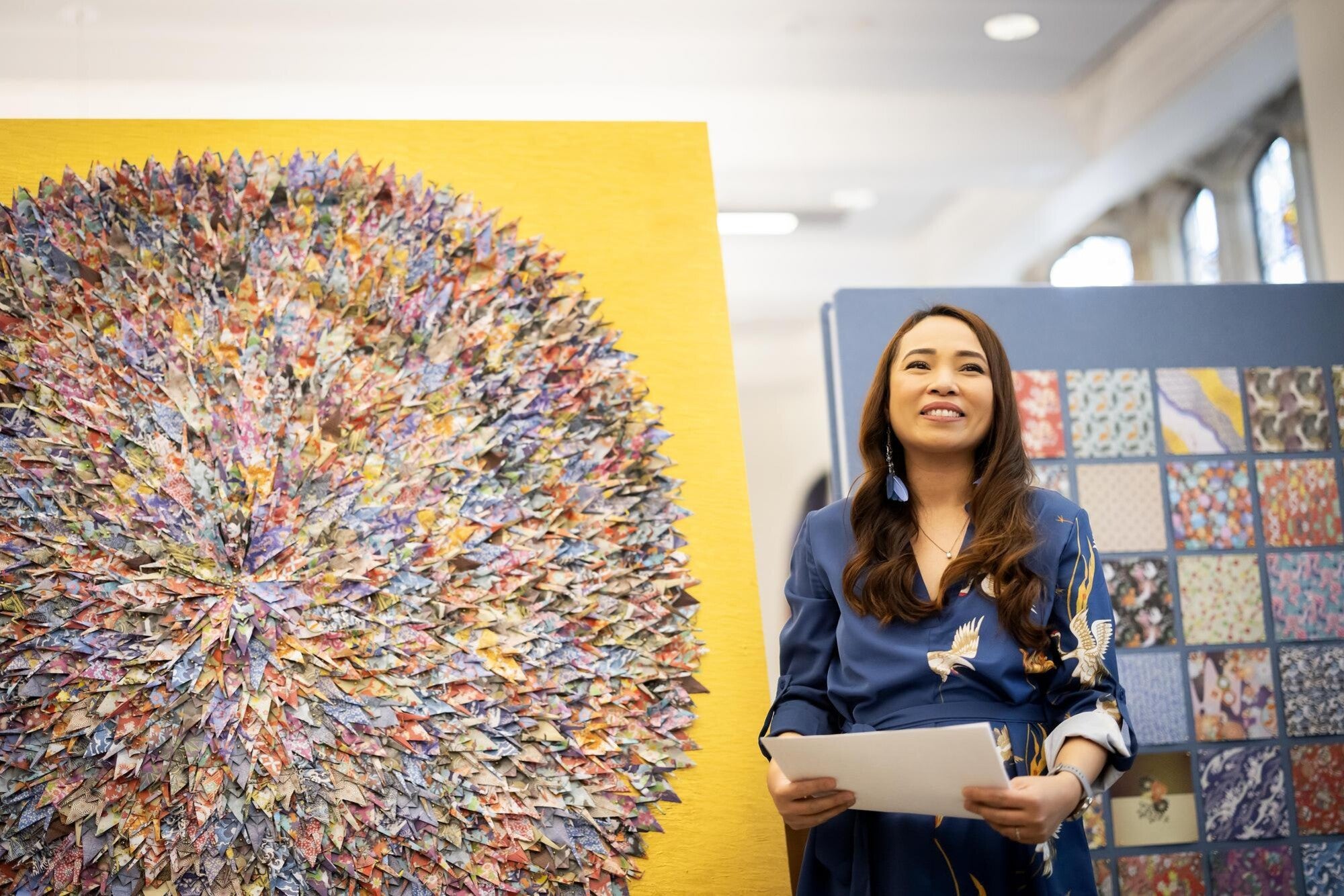
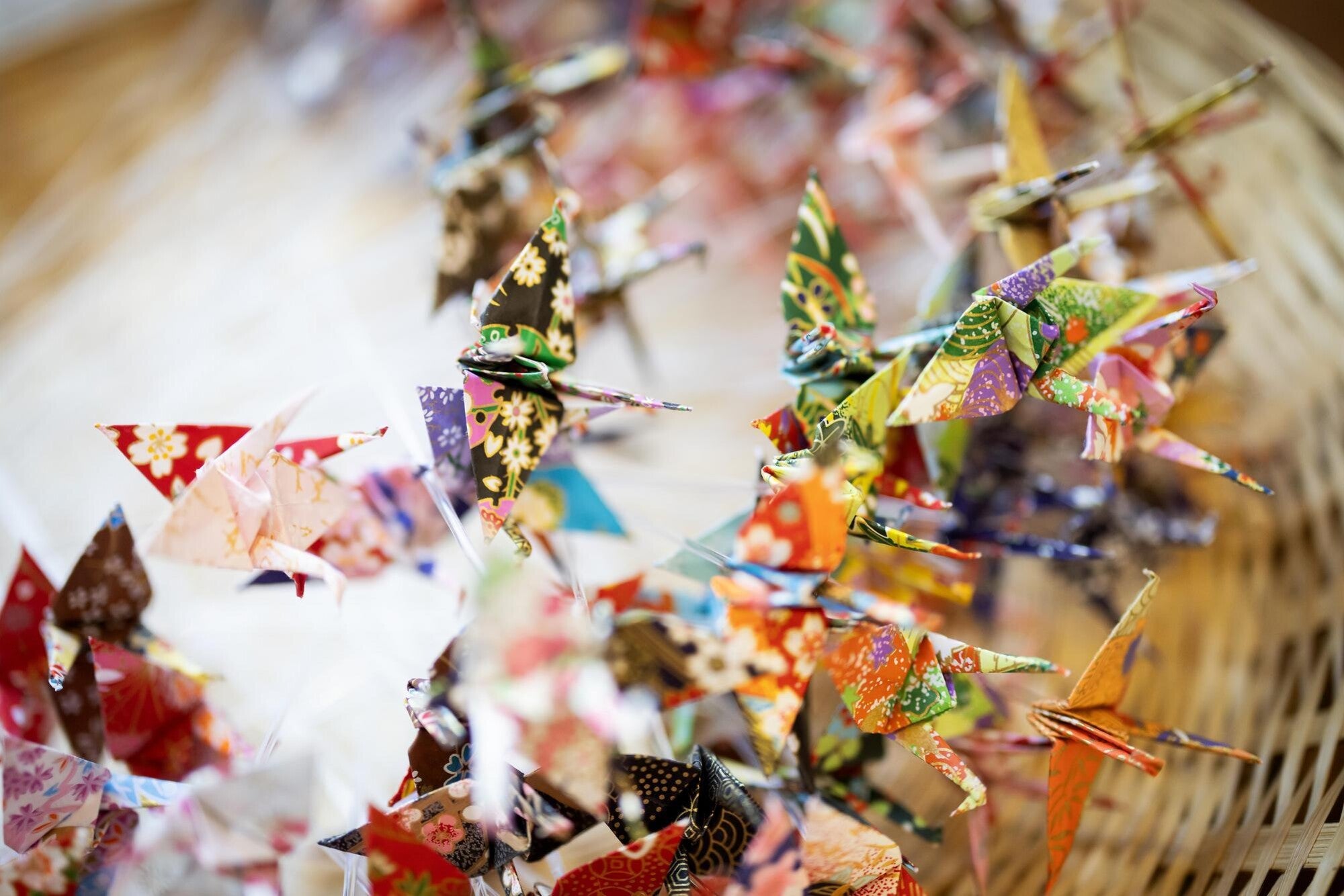
The PAACH team—Long and associate directors Vicky Faye Aquino and Daniel Hoddinott, and program coordinator Cindy Au-Kramer—asked the crowd to form a circle, count to three, and then unveiled a large canvas with a central mandala. Looking closer, 1,000 paper cranes comprise the mandala, all intricately folded with decorative origami paper.
The mural, “1,000 Paper Cranes Mandala,” is the handiwork of Aquino. “On my first day at PAACH, I noticed tiny paper cranes hung from a pillar and they provided a warm and colorful welcome to the space,” she said. In planning and designing this year’s mural, Aquino chose to create 1,000 origami cranes by hand, alone, over the course of three months.
“In Japanese culture, cranes symbolize longevity and fortune. It is believed if you fold 1,000 cranes and make a wish, your wish will come true,” explained Aquino. “The cranes symbolize hope, healing, and strength in challenging times.”
Aquino chose to mount the cranes in the shape of a mandala, which means “sacred circle” in Sanskrit. “It became a meditation for me; it takes patience, dedication, and focus. I gave birth eight months ago, and I got to share the experience with my newborn daughter. She was strapped to me while I folded cranes.”
“Despite the kind offers I accepted no help,” she added. “I was committed to doing it myself so I can have my wish granted. I’m grateful for the opportunity to bring the community together through art. Like a paper crane, we are shaped by each fold, delicate yet resilient, grounded in patience and possibility. So, give yourself a challenge, commit to it, and pour your heart into it a thousand times.”
Aquino then asked everyone to close their eyes, make a wish, and whisper it to the paper crane. After they opened their eyes, Aquino revealed her wish: “My wish is that all your wishes come true.”
Weitzman Student & Alum Designate Penn’s Oldest Property to Philadelphia Historic Register
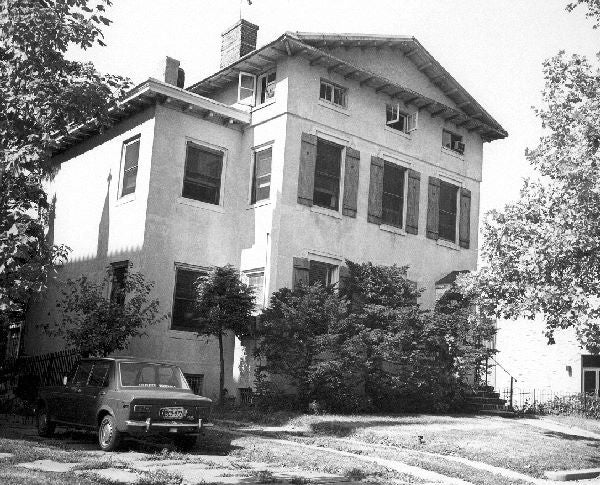
Ke-An Chiang (MSHP’25), uncovered the 250-year history of the Greenfield Intercultural Center at 3708-12 Chestnut Street, which served several families as a suburban villa before being acquired by the University in 1982.
The building that houses Penn’s Greenfield Intercultural Center has been listed on the Philadelphia Register of Historic Places, thanks to a nomination authored by Ke-An Chiang, a Master of Science in Historic Preservation (MSHP) student at Weitzman.
Built circa 1845, the Reed-Hubley Residence, a 3-story villa at 3708-12 Chestnut Street, is believed to be the oldest building owned by the University of Pennsylvania, outside of Hospital properties.
Chiang conducted original historical research for the nomination in the Fall 2023 semester of HSPV 6000 Documentation, Research, and Recording I, taught by Francesca Ammon, associate professor of city and regional planning and historic preservation; Kecia Fong, senior lecturer in historic preservation; and the late Aaron Wunsch, an associate professor of historic preservation.
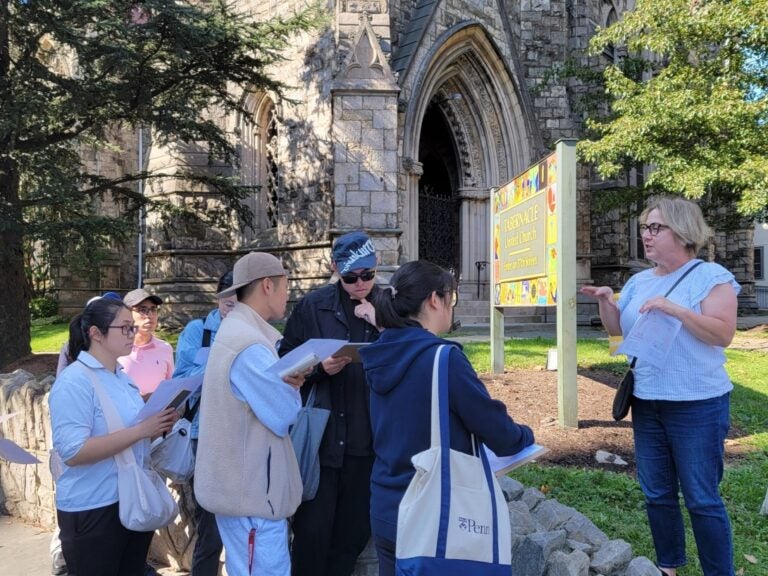
The instructors then passed Chiang’s final paper on to Amy Lambert, a preservation alum from 2016 who serves as the president of the board for the University City Historical Society (UCHS). UCHS sponsored the nomination for submittal to the Philadelphia Historical Commission, which voted unanimously to designate the property on March 15.
Ke Feng (MArch’98), senior architect in the Office of the University Architect, spoke at the Historical Commission meeting on behalf of the University. “We’re very happy and grateful for this nomination,” he said, “so we support that designation to the Philadelphia Register of Historic Places.”
Site designation is one of the fundamental tools of historic preservation at the local, state, and national levels. Nominations document the historic significance of their subject property and, if approved, can afford those properties protections going forward.
Developing historical arguments for the significance of sites is the core of the Documentation I course. In her nomination, Chiang argues that the structure merited designation because it stylistically reflects a suburban aesthetic preference during a rapidly industrializing period, and exemplifies the moment Greek Revival architecture began to turn toward the Italianate.
Further, she argues that it is emblematic of the changing social history as the area developed as a “streetcar suburb” in the late 1800s, a new urban form enabled by the burgeoning technology of the rail-born horse-drawn streetcars. Chiang combined original deed research at the City Archives with historic newspapers to craft a narrative about the people who occupied 3708 Chestnut.
“I live on Chestnut Street, so I saw that building a lot,” Chiang remembers. “But I never thought that I could dig into the history so much and find an argument for the building. I did have fun in putting all these together.”
“Documentation I is a foundational course for all historic preservation students,” notes Ammon. “Whether they intend to focus on materials-based conservation, adaptive or new designs in historic settings, preservation planning, or the public history side of the field, our graduates will all need to know how to research the history of a building, site, or neighborhood. This course equips them with the archivally-based research skills to establish that starting point.”
Each year, course instructors select a focus neighborhood in Philadelphia. 2023 students’ properties clustered around Spruce Hill, a West Philadelphia neighborhood with the largest intact collection of Victorian architecture in the country.
In addition to the excess of historic character, the neighborhood selection was strategic in its timing: that October, Spruce Hill Civic Association (SHCA) submitted an historic district nomination for the third time in almost four decades. In July 2024, the Southeast Spruce Hill Historic District, nominated in partnership with UCHS, was designated to the local Register, safeguarding all properties within its boundaries from demolition.
Most of the other HSPV 6000 students’ properties will likely be protected under the auspices of this or a further three proposed historic districts within Spruce Hill. 3708 Chestnut is not within those boundaries and held the potential for designation based upon its individual significance. The property therefore warranted an individual nomination.
Wunsch, a former resident of Spruce Hill, knew about the neighborhood’s upcoming designation effort, which was launched in response to increased demolition and gentrification to the north.
Ammon explains, “Aaron had been keeping a running list of buildings in the area that could possibly merit designation based upon their architectural significance. As our students dug into these properties, however, they oftentimes uncovered meaningful social and cultural stories that went beyond architecture alone, demonstrating the many rich layers of history embodied in the built environment all around us.”
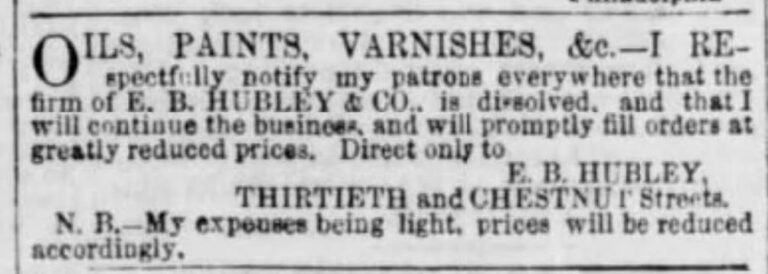
To illustrate the structure’s rich social history in her nomination, Chiang included an advertisement for E.B. Hubley’s art supply business. While preparing the nomination for submittal, Lambert noticed a significant name within Chiang’s detailed chain of title: Rubens H. Peale. After further digging, Lambert discovered that the Hubley family were related by marriage to the renowned artist Charles Willson Peale. Including this connection in the final document gave further meaning to the social history of the site, and demonstrates the collaborative nature of the work Chiang and UCHS did.
The quality of the nomination helped it sail through the Committee on Historic Designation, which reviews applications before they appear before the full Historical Commission, and which, Lambert notes, was composed of Wunsch’s former friends and colleagues.
As Lambert said in her remarks at March 15’s Historical Commission meeting, “It’s a wonderful reminder of the long shadow our friend Aaron Wunsch still casts in our beloved city.”
Continued growth at the LGBT Center
Almost one year into their new role as director, Eric Anglero looks to support students and community with robust programming and a place where ‘you can just be.’
One night a month, LGBT Center director Eric Anglero sits down with Center staff, faculty, and students for the Shapiro-Bezdek Family Dinners, a beloved tradition that was recently endowed by Penn alumnus Stuart Shapiro and their husband Rick Bezdek. The dinners create an environment of support for the LGBT community on campus and offer a moment, Anglero says, where “you can just be.”
Anglero has been in their new role for nearly a year and has plans for the Center’s continued growth, creating inclusion for people with marginalized genders and sexualities, both inside the LGBT Center itself and at Penn as a whole. “We are really trying to broaden what success looks like here beyond the walls of the Carriage House,” says Anglero, referring to their historic building just off Locust Walk.
In November, the Center hosted the Trans Day of Remembrance and Trans Week of Visibility in collaboration with the William Way LGBT Community Center in Philadelphia, along with partners at Penn, including Penn Carey Law, the Office of the University Registrar, and the Program in Gender, Sexuality, and Women’s Studies (GSWS). The Registrar hosted a clinic to explain how to change your birth name, and GSWS presented on the Trans Oral History Project, a community engagement initiative that preserves and makes publicly accessible the stories of trans, nonbinary, and gender-nonconforming people.
The weeklong programming is meant to both support trans community members at Penn as well as to hold “a place of mourning, of grief, of understanding the violence that has happened to trans communities across the globe,” Anglero says.
In the spring, the Center will welcome Chase Strangio of the American Civil Liberties Union, in partnership with Penn Carey Law as this year’s second scholar-in-residence. Events planned include Q Penn, the Center’s annual Pride Week beginning April 7, as well as Lavender Graduation, a celebration for the accomplishments of the graduating LGBTQ+ cultural community.
As part of University Life, connections and partnerships exist across the cultural centers, Anglero says. “There is so much infrastructure here we can strive to work with,” they say, noting that those intercultural connections can be impactful for students. Anglero also plans to continue partnering with queer and trans organizations in Philadelphia, including William Way, the Mazzoni Center, and even the Stonewall Sports League, which they participate in.
Who, What, Why: Laurie McCall, director of the Platt Student Performing Arts House
Laurie McCall leads the staff at the Platt Student Performing Arts House, which supports Penn’s 70-plus groups that stage more than 100 comedy, spoken word, dance, theater, voice, and music events each year.
Who
Laurie McCall is the director of the Platt Student Performing Arts House, as well as staff coordinator of the PennQuest Pre-Orientation Program. She has been at with University Life since 1992, starting as assistant director of New Student Orientation. Since 2007, she has been at the Platt House, which opened the previous year with support from Penn alums Marc and Julie Platt, first as associate director and since 2013 as director. Her undergraduate degree is in education and her graduate degree in communication.
What
McCall leads the staff at the Platt House, which supports Penn’s 70-plus groups that stage more than 100 comedy, spoken word, dance, theater, voice, and music events each year, involving more than 1,400 undergraduates. The Platt House also provides trainings, workshops, masterclasses, and career mentorship, connecting students with alumni in the field. And it facilitates youth arts mentorship, community outreach, and engagement with the regional arts industry.
“We provide a scaffold of support with resources, care, and advice to our students who are in performing arts groups who want to perform,” McCall says. “But we are also advocates to make sure that they have what they need to perform on campus.”
A big part of her job is helping to solve problems. A continual challenge is finding and securing and allocating space for rehearsals and performances in buildings throughout the campus. She is very much looking forward to the 2027 opening of the new student performing arts center at 33rd and Chestnut streets; construction started in September. The Platt House team will manage the programming in the new performance center.
Another role is to support the student Performing Arts Council (PAC), which governs the 45 groups that have priority for show spaces and Student Activities Council funding. McCall and her team of five also are in contact with the 35-some independent groups and help when needed. Two manage the PAC Shop, which helps students with set-building and technical needs.
And part of what McCall does is answer the call when the students are trying to manage a challenge and ask for direction. “They don’t always know how to handle conflicts within their groups, and we are helping them do that,” McCall says. “I focus on trying to make sure that they understand what it means to be inclusive.”
Also, she encourages students to enjoy their time in performing arts, to keep their passion, to try not to get stressed out, and to focus on the friendships and the fun.
McCall was a stage manager when she was in school: “I’m still stage-managing in the way that you’re getting everyone what they need in the time that they need it.” She also manages the PennQuest Pre-Orientation experience, selecting and training Penn student volunteers who lead a group of 130 incoming first-year students on a camping and hiking trip in the summer.
“I’m a person who has been managing student group activities my whole life,” she says.
Why
Student performing arts are woven into the fabric of the University, included in every formal occasion and other events, she says. And the experiences for the students involved form lasting impressions and friendships, McCall says, and she is proud to play a part.
“I would like every student and every student club to have an advisor who they can come to with their issues. I know the pressure that students have academically and timewise, and I don’t want their extracurricular life to be part of that. Extracurriculars should be where they can release their stress,” McCall says. “My goal is to improve their quality of life, especially through the arts, which encompasses so many life lessons and touches so many people. I want to be able to help them in any way I can.”
A calendar of the dozens of student performing arts productions scheduled for this fall is available on the Platt House website.
La Casa Latina celebrates 25 years of history during Latinx Heritage Month
La Casa Latina is offering a range of events in celebration of its 25th anniversary and Latinx Heritage Month.
La Casa Latina, the main center for Latinx students at the University, organized a schedule for the month featuring panel discussions, an author talk, student gatherings, and conferences. It also hosted a symposium on Sept. 21 recognizing a quarter-century of “dedicated service, advocacy, and cultural empowerment,” according to La Casa Latina Director Krista Cortes.
“This anniversary is not just a recognition of the center’s founding but a reflection on the collective efforts of its founders and the ongoing work required to serve a dynamic and diverse Penn Latine community,” Cortes said.
The celebration commenced with the Procession of Flags on Sept. 16, where students marched down Locust Walk holding the flags of Latin America. The event was followed by an Open House of La Casa Latina.
On Sept. 21, a symposium centered around La Casa Latina’s 25th anniversary took place at the ARCH Building, featuring two panels and an award luncheon.
The first panel reflected on the center’s evolution and impact since its establishment in 1999. Founding members Luz Marin and Jorge Santiago-Aviles spoke on the panel, as well as Nursing senior Salvador Galvez Jr. The second session featured the perspectives of students and recent graduates on the intersections of identity and activism.
In her remarks at the symposium, Cortes described the cultural center as a “landing space” for students.
She highlighted the establishment of the Latinx Graduation Ceremony in 2021, which offers a bilingual graduation in English and Spanish as students walk the stage with their parents and relatives. La Casa Latina also invites cultural dancers, musicians, and speakers to perform at the graduation. Cortes said that the initiative emerged from student efforts after the COVID-19 pandemic disrupted many of their formative years.
La Casa Latina gave out seven awards to students and faculty to celebrate their contributions to Penn’s Latin community. The two Service & Dedication Awards went to retired office coordinator Maritza Santiago Torres and Johnny Irizarry, who is the longest-serving director of La Casa Latina.
Amelia Becerra, a College junior and La Casa Latina program assistant, said during the symposium that it’s always “nice to see alumni come back, as they help me believe it is possible to do something here and to see that they’ve all been successful really validates my experience.”
On Sept. 26, graduate students congregated in Castor Courtyard for the Graduate Student Bienvenida. To conclude September’s celebrations, Luis Miranda Jr., a Puerto Rican author, visited the University on Sept. 30 to discuss the role of Latinx voices in politics.
Future events for October include the Dolores Huerta lecture and the 7th PLAC Conference, which will discuss public and community-engaged scholarship in Latin America, the Caribbean, and its diaspora.
College senior and La Casa Latina program assistant, Andrea Barajas, who was also a photographer for the Daily Pennsylvanian, said that planning these events didn’t come without challenges.
During previous Latinx Heritage Months, La Casa Latina hosted events nearly every day. This year, to remedy the stress of organizing such frequent events, Barajas said that La Casa Latina is focusing on “recognizing their capacities and limitations.”
Barajas added that La Casa Latina has worked to plan fun events despite funding options becoming more limited. For example, she led an event in February where she made paper flower bouquets, having purchased paper and fake flowers in bulk from Amazon.
“We’ve had to get a bit more conservative with the financial aspect, but that also means we get to be a little more creative with it,” Barajas said.
Galvez Jr. said that La Casa Latina has greatly evolved since he joined as a first year, especially in terms of engagement and outreach.
“It seems like there are a lot more Latine students on campus, and I think those students are finding the space of La Casa,” Galvez Jr. said. “A part of me is really proud of the work that we’re putting into making sure that people know we’re a center, a resource for them.”
Galvez Jr. also said that there has been an increase in programming and event planning, highlighting the establishment of the bilingual graduation.
“Latine graduating students at Penn always share that that’s something really special to them, especially when their parents may not speak English or come from immigrant households,” Galvez Jr. said. “Having a graduation that they can participate in and semi-understand is really nice as well.”
Looking ahead, La Casa Latina aims to engage with the broader Philadelphia Latinx community, build connections with Latinx alumni, and compile a digital archive of Latinx legacies at the University. In 2025, La Casa Latina will launch a scholars program that supports undergraduate and graduate students.
“Our main goal is to increase our visibility and really show administration and continue to show students that we are a resource for them,” Galvez Jr. said.
A Home on Campus
The Greenfield Intercultural Center celebrates 40 years of community building.
When College senior Timethius Terrell was losing motivation to continue his non-profit startup focused on intercultural allyship, he turned to the Albert M. Greenfield Intercultural Center (GIC) for help.
Not only did GIC director Valerie de Cruz CGS’02 and associate director Kia Lor GEd’16 provide guidance, but Terrell has also become one of the many regulars at the center, which for 40 years has been a haven for people of all ethnicities, backgrounds, and nationalities to come together and breathe after a hard day at Penn. He even interned at GIC during the summer of 2022.
“I still consider myself to be an active member of this community,” Terrell said this spring. “Maybe not as formally,” he allowed. “I think that’s what makes it special, though—you don’t have to be.”
The Greenfield Intercultural Center was established in 1984, six years after the United Minorities Council, a coalition of minority student organizations, signed a petition to have its own space on campus.
To mark its 40th anniversary, the GIC is holding events throughout the year, including a celebration in their building at 3708 Chestnut Street that took place on January 27—exactly 40 years after its founding. The celebration included musical performances, cake-cutting, and the presentation of awards to Penn alumni who were recognized for embodying the spirit of the GIC through work in their communities. One of the honorees, Angbeen Saleem C’12—a creative artist, writer, and poet who “spent all of my free time at the GIC” as a work-study student there—read two poems she had written for the event.
“A lot of these alumni come back and they bring their kids and they say hi to Val,” remarked College senior and GIC work-study student Oumy Diasse. “You could kind of just look around and see everyone’s super familial.”
In addition to providing a friendly space for students to meet casually and share meals, the GIC also sponsors events related to culture and race and has helped establish and nurture programs and organizations for minority groups including the Persian Student Society, the Turkish Student Organization, and Natives at Penn [“Native Pride,” Jul|Aug 2019], which marks its 30th anniversary this year. It also helped to launch Makuu: The Black Cultural Center, the Pan-Asian American Community House (PAACH), and La Casa Latina Center, all of which are currently based at the revamped ARCH building on Locust Walk [“Gazetteer,” Nov|Dec 2022]. In 2016, Penn’s First-Generation Low-Income Program (FGLI) opened in the GIC, which also started an alumni mentorship program for FGLI students called Penn FLASH.
The January 27 celebration brought many alums back. “A lot of the stuff I do now is connected to my time here,” said Sean Vereen GEd’00 GrEd’05, who was the associate director of the GIC from 2003 to 2006 and now runs the Philadelphia-based college and career-access program Steppingstone Scholars. De Cruz, who’s served as the GIC’s director for the last 27 years, is another reason alumni love to return. “[Valerie] has a real power to stay connected to people,” Vereen noted. “She makes them feel like individuals. And she has weathered all the changes on campus and been able to maintain [the GIC].”
“I think the most important thing I bring is the building of relationships,” said de Cruz.
For current work-study student and College sophomore Kaynath Chowdhury, “the GIC’s a home.” At the center she often finds herself washing dishes, taking out the trash, giving tours, helping with events, and greeting people at the door. It’s a far cry from office work, she says; it’s more like what she would do at her own family’s house.
The familial atmosphere seemed to make an impression on College freshman Theo Greenfield C’27, the great-grandson of prominent Philadelphia-based businessman Albert M. Greenfield, whose foundation supplied the grant to launch the GIC. An additional $1 million gift from the Albert M. Greenfield Foundation a decade ago helped to endow the GIC and increase staffing and expand its programs.
“There are people here who have dedicated their lives to not just the GIC but the mission of the GIC as an intercultural center,” said Theo, who came to the anniversary event largely out of curiosity. “It’s honestly inspiring. … I would like to become more involved.”
While the 40-year milestone provided a welcome chance to celebrate the work that has gone into making the GIC what it is, attendees were also looking ahead. “Places like the GIC are not just havens but really the center of the work that the University has to do in the future,” Vereen said.
“If you don’t see yourself envisioned in this space,” de Cruz said, “come tell us how you can envision yourself in this space, and we will work with you to create that. And that will in turn change Penn. That’s the story.”
—Hannah Chang C’27